Play Le Pharaoh Now!
Home → Symbols & Payouts
Le Pharaoh Symbols
Symbol set of Le Pharaoh
The reel layout of Le Pharaoh consists of 6 reels, creating a grid that supports 19 paylines for standard symbol matches. This configuration differs from the 6x5 setup found in Le Cowboy, which also utilizes six vertical columns but may vary in horizontal alignment. Players must align symbols across these fixed lines to generate payouts based on the specific paytable values assigned to each icon type.
Le Pharaoh paytable and grid
| Grid | 6x5 |
| Paylines / ways | 19 |
| Bonus trigger | 3, 4 or 5 FS symbols trigger one of the bonuses |
A medium volatility rating applies to this slot, indicating a balance between frequent small wins and occasional larger payouts over extended play sessions. The theoretical return is set at 96.18%, meaning the house edge remains constant at 3.82% across all qualifying spins regardless of bet size or symbol combination used during gameplay.
The maximum win cap stands at 15000x the total stake, offering substantial potential returns for players who successfully trigger high-value feature combinations within the game loop. This ceiling limits the absolute payout amount compared to titles like Le Cowboy, where the maximum win reaches 25000x, thereby affecting the risk-reward profile for high-stakes wagering strategies employed by experienced users.
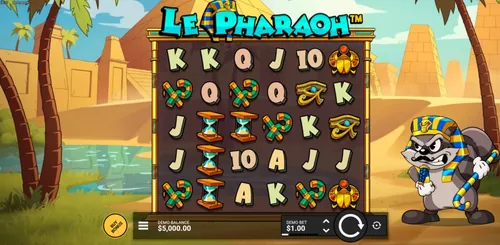
High-paying symbols
High-paying symbols in Le Pharaoh are represented by themed icons such as scarabs and pyramids, which award the largest payouts when five match on an active payline. These premium symbols carry higher value multipliers than their low-tier counterparts, contributing significantly to the overall return percentage of 96.18% over thousands of spins.
Sticky Re-Drops mechanics can enhance wins from these high-value icons by keeping winning reels in place while new symbols drop into empty spaces below. This feature increases the probability of forming additional winning combinations on subsequent spins without requiring extra bets, effectively extending the value derived from each successful high-symbol alignment event.
Unlike Le Cowboy, which also features high-paying thematic symbols within its 6x5 grid, Le Pharaoh restricts its top awards to the Egyptian motif exclusively. The presence of these distinct visual elements ensures clear differentiation between symbol tiers, helping players identify potential winning patterns more easily during fast-paced gaming sessions on desktop or mobile devices.
Low-paying symbols
Low-paying symbols in Le Pharaoh include stylized card ranks from nine through Ace, depicted with Egyptian artistic flair to maintain thematic consistency throughout the interface. These icons offer smaller base payouts but appear more frequently than premium symbols, helping to sustain player engagement during dry spells between major wins.
The inclusion of these lower-tier icons contributes to the hit frequency of the slot, ensuring that even non-winning spins often result in partial symbol matches that keep the reels active. While they do not trigger bonus features directly, their regular appearance helps mitigate the impact of medium volatility by providing steady, albeit modest, returns on invested capital.
Compared to Le Cowboy, which shares similar structural design principles, Le Pharaoh uses unique graphical representations for its low-value cards to reinforce the ancient narrative. This aesthetic choice does not alter the mathematical odds but enhances the visual experience, making the distinction between high and low symbols immediately recognizable to attentive observers monitoring the paytable closely.
Wild symbol behaviour
The Wild symbol in Le Pharaoh substitutes for other regular symbols to complete winning combinations on active paylines, excluding special Scatter icons that have independent triggering rules. This substitution capability increases the likelihood of landing profitable alignments, particularly when combined with the Sticky Re-Drops feature that keeps winning reels stationary for further evaluation.
Wilds do not replace Scatters, preserving the integrity of bonus triggers that rely on specific scatter counts rather than adjacent line matches. This restriction ensures that players cannot accidentally convert a potential free spin round into a standard line win, maintaining the strategic depth required to maximize returns from the 15000x max win potential offered by the game engine.
In contrast to Le Cowboy, where wild behavior may vary depending on specific game modes, Le Pharaoh maintains consistent substitution rules across all base game spins. This uniformity allows players to predict outcomes more accurately, reducing uncertainty during high-variance periods and supporting more informed betting decisions based on known symbol interaction mechanics.
Scatter symbol behaviour
The Scatter symbol in Le Pharaoh pays regardless of its position on the reels, functioning independently of the 19 active paylines that govern standard symbol matches. This positional freedom allows Scatters to trigger payouts or bonus rounds even when appearing on isolated reels, increasing the opportunities for rewards during any given spin cycle.
Unlike Wilds, Scatters do not substitute for other symbols but instead act as key indicators for special features, often initiating free spin rounds or multipliers that enhance overall winnings. Their ability to trigger bonuses from any location adds a layer of unpredictability that complements the medium volatility setting, keeping players engaged through varied reward structures.
Le Cowboy also employs Scatter symbols with similar positional independence, yet Le Pharaoh’s implementation ties directly to its Egyptian theme through unique visual designs. This thematic integration does not change the mathematical function but reinforces brand identity, ensuring that players recognize bonus triggers instantly while distinguishing them from regular paying symbols on the grid.
Le Pharaoh: key facts
| Parameter | Value |
|---|---|
| Game | Le Pharaoh |
| Studio | Hacksaw Gaming |
| RTP | 96.18% |
| House edge | 3.82% |
| Volatility | medium |
| Max win | 15000x |
| Reels | 6 |
| Paylines / ways | 19 |
Reading the paytable
Le Pharaoh operates on a 6-reel, 5-row grid with 19 active paylines, establishing the structural foundation for all symbol evaluations. This layout differs from Le King, which utilizes an identical 6x5 reel matrix but relies on distinct internal logic for its payout calculations. Players must examine the specific symbol values against this fixed line count to understand potential returns.
The theoretical RTP of 96.18% represents the long-term average return over hundreds of thousands of spins, defining the house edge at 3.82%. Alternative configurations exist in circulation at 94.33%, 92.26%, and 88.24%, meaning the actual return depends on the specific server instance. Understanding these percentages is essential before analyzing individual payline outcomes or feature triggers.
Wild symbols substitute for other icons to complete winning combinations along the defined paylines, while scatters pay regardless of their position on the reels. Scatter payouts typically trigger the bonus round, bypassing the standard left-to-right adjacency requirement of traditional paylines. This dual mechanism allows wins to occur even when symbols do not align perfectly on the 19 active lines.
How wins are calculated
Wins are determined by matching three or more identical symbols starting from the leftmost reel along one of the 19 available paylines. The maximum win cap for Le Pharaoh stands at 15000x the total bet size, setting a strict upper limit on potential payouts. This ceiling applies to all winning combinations, including those generated during special features like Sticky Re-Drops.
The volatility rating of medium suggests a balance between frequent smaller wins and occasional larger payouts, unlike the high-variance profile of Le King. Le King offers a higher max win of 20000x, indicating that its win distribution skews toward less frequent but potentially larger events. Le Pharaoh’s medium volatility implies a steadier stream of returns relative to its 15000x cap.
Each winning combination’s value is multiplied by the bet per line, which is derived from the total stake divided by the 19 active paylines. For example, a €1.00 total bet results in a €0.0526 wager per line, scaling all symbol payouts proportionally. This calculation method ensures that the 15000x maximum win scales linearly with the player’s chosen bet size.
Line wins versus ways wins
Le Pharaoh utilizes a fixed system of 19 paylines rather than a flexible ways-to-win mechanic, requiring symbols to match specific patterns. A payline is a fixed pattern across the 6x5 grid, whereas ways-to-win counts any adjacent match from the leftmost reel without predefined paths. This distinction means only alignments on the 19 designated lines qualify for standard symbol payouts.
Scatter symbols operate independently of the 19 paylines, paying out based solely on quantity and position rather than adjacency. While regular wins depend on the strict geometry of the paylines, scatter triggers often initiate bonus rounds like Sticky Re-Drops. This separation allows for additional value generation outside the standard line-based calculation framework.
Comparing this to Le King reveals that both titles use the same 6x5 physical reel layout but may differ in how they evaluate matches. Le King’s mechanics might emphasize different alignment rules, yet Le Pharaoh strictly adheres to its 19-line structure for base game wins. Players seeking ways-to-win flexibility might find Le Pharaoh’s fixed-line approach more restrictive than alternative titles.
Bet size and symbol value
The total bet size directly scales all potential payouts up to the 15000x maximum win cap, making stake selection critical for bankroll management. Each spin’s cost is distributed across the 19 paylines, ensuring every line has an equal opportunity to form a winning combination. Higher bets increase the absolute value of each symbol match without altering the underlying probability or RTP.
Symbol values vary significantly, with premium icons offering higher multipliers than low-paying card ranks within the Egyptian theme. The 96.18% RTP is achieved through a weighted distribution of these symbol values across the 6x5 grid. Understanding which symbols contribute most to the return helps players gauge the frequency of small versus large wins.
Le King shares the same developer, Hacksaw Gaming, and similar volatility, but its 20000x max win suggests higher-value top symbols or better bonus hit rates. Le Pharaoh’s 15000x cap indicates a slightly more conservative payout structure compared to its sibling title. This difference affects the potential upside for high-stakes players betting near the maximum limit.
Multipliers on the reels
Sticky Re-Drops serve as the primary multiplier mechanism in Le Pharaoh, enhancing wins during the bonus feature triggered by scatters. These re-drops keep winning symbols in place while new ones fill empty spaces, creating chains of consecutive wins on the 6x5 grid. This feature leverages the medium volatility to extend playtime and accumulate multipliers beyond the base game rates.
The theoretical RTP of 96.18% includes the expected value contribution from these sticky re-drop sequences, balancing the 3.82% house edge. Without such features, the base game return would likely be lower, relying solely on the 19 payline alignments. The multipliers effectively boost the long-term return by increasing the frequency of significant wins during the bonus phase.
Le King also employs Hacksaw Gaming’s signature mechanics, but its 20000x max win potential may stem from more aggressive multiplier stacking. Le Pharaoh’s 15000x cap limits the ultimate payout from these sticky sequences, capping the benefit of extended bonus rounds. Players should note that the multiplier effect is constrained by this hard ceiling, unlike games with higher caps.
Special symbols in the bonus
Le Pharaoh uses wild and scatter symbols to activate its core mechanics, where a wild substitutes for other standard icons to complete paylines. In contrast, Wanted Dead or a Wild operates with high volatility and a distinct 5-reel layout, offering a different structural approach to symbol interaction than Le Pharaoh's 6-reel system. This distinction clarifies that Le Pharaoh relies on adjacent matches from the leftmost reel rather than fixed payline patterns alone.
The scatter symbol pays regardless of its position on the grid and typically triggers the main bonus round within the 19 ways-to-win framework. While Wanted Dead or a Wild caps its maximum win at 12500x, Le Pharaoh allows for a significantly higher potential payout of 15000x through its unique feature set. Players must understand that the scatter does not guarantee a win but serves as the entry key to the Sticky Re-Drops mechanic.
Sticky Re-Drops constitute the primary special feature, allowing winning symbols to remain in place while new ones fall into empty spaces above them. This mechanism differs fundamentally from crash games, which offer manual cash-out buttons; Le Pharaoh is strictly an online slot with no such intervention option available. The absence of a cash-out button means players cannot secure partial profits during a winning chain, relying entirely on the mathematical model.
Symbol upgrades and collections
The game employs an Egyptian theme where premium symbols are designed to upgrade or collect during specific feature sequences within the 6x5 grid. Unlike Wanted Dead or a Wild, which utilizes a simpler 5-reel structure, Le Pharaoh's expanded reel count provides more opportunities for these upgrades to occur across the 19 ways. This structural difference impacts how frequently high-value combinations can form during extended bonus rounds.
Premium symbols contribute to the collection mechanic, which is essential for unlocking the highest tiers of rewards in the bonus round. The theoretical return of 96.18% reflects the long-term average of these upgrades over hundreds of thousands of spins, not immediate session results. A house edge of 3.82% applies to this return rate, ensuring the casino maintains a statistical advantage regardless of short-term symbol clustering.
Other RTP configurations exist in circulation at 94.33%, 92.26%, and 88.24%, indicating that operator settings may alter the frequency of these symbol upgrades. Players should verify the active configuration because a lower RTP reduces the expected value of collected symbols over time. Le Pharaoh remains a medium volatility title, balancing the risk of losing streaks against the potential for significant symbol-based payouts.
Grid layout and symbol positions
Le Pharaoh features a 6-reel by 5-row grid that supports 19 ways to win, providing a wider playing field than the standard 5-reel format used by many competitors. For instance, Wanted Dead or a Wild uses only 5 reels, which changes the probability distribution of adjacent symbol matches compared to Le Pharaoh's layout. This extra reel increases the complexity of the paytable and the number of possible winning combinations per spin.
Ways-to-win counts any adjacent match starting from the leftmost reel, meaning symbols do not need to align on a specific diagonal or horizontal line. This rule applies uniformly across all 19 ways, distinguishing it from fixed payline games where specific patterns are required for a payout. The 6-reel structure ensures that even scattered symbols on the initial reels can potentially connect with those on the sixth reel.
The maximum win cap is set at 15000x the total bet, representing the absolute ceiling for any single spin or bonus sequence in the game. This limit is higher than the 12500x cap found in Wanted Dead or a Wild, offering greater upside potential for players betting on the 19 ways. Understanding this cap is crucial for bankroll management, as hitting the maximum requires rare alignment of premium symbols across the entire grid.
Frequency of premium symbols
Premium symbols appear with a frequency dictated by the medium volatility setting, balancing between frequent small wins and rare large payouts. The base RTP of 96.18% suggests a standard distribution of these symbols over a very long run, though individual sessions may deviate significantly. Players should expect fewer premium hits compared to low volatility slots, as the game prioritizes larger payouts during feature triggers.
The 300% welcome bonus up to €2,000 plus 100 free spins affects how quickly premium symbols can be capitalized upon by extending playtime. With a wagering requirement often attached to such bonuses, the effective cost per spin decreases, allowing for more opportunities to hit premium combinations. However, the house edge of 3.82% remains constant, meaning the expected loss per spin is proportional to the bet size regardless of bonus usage.
Alternative RTP versions like 94.33% or 88.24% would reduce the frequency of premium symbol appearances, altering the game's volatility profile effectively. At 88.24%, the house edge rises to 11.76%, making premium symbols much rarer and reducing the overall return to player. Le Pharaoh's advertised 96.18% represents the most favorable configuration, ensuring the best statistical chance for premium symbol hits among the available options.
Paytable details worth checking
The paytable outlines the values for each symbol tier, with the highest payouts reserved for premium icons that trigger the Sticky Re-Drops feature. Unlike Wanted Dead or a Wild, which has a max win of 12500x, Le Pharaoh's paytable supports a higher ceiling of 15000x for perfect alignments. This detail confirms that the game is designed for high-variance players seeking substantial returns from a single successful bonus round.
Scatter symbols pay regardless of their position on the 6-reel grid, providing a safety net for non-winning spins that still yield returns. This mechanic ensures that even without triggering the main bonus, players receive some return based on the scatter value defined in the paytable. The 19 ways-to-win system amplifies this effect by allowing multiple scatter-induced payouts if they appear in adjacent positions across the reels.
RTP variations of 94.33%, 92.26%, and 88.24% imply that paytable values might differ between operator versions, affecting the actual payout for each symbol tier. A version with 88.24% RTP likely reduces the multiplier values for premium symbols compared to the 96.18% baseline. Players should check the specific game rules to ensure they are playing the version with the highest theoretical return and corresponding paytable generosity.
DemoRTP & VolatilitySymbols & PayoutsBonus FeaturesStrategyBonusesMobileDownload & AppMax WinSimilar GamesReviewFAQSitemap
Le Pharaoh 2026